 AW 106
 AW XVIII.5
 AW XVIII.4
 AW XVIII.3
 AW XVIII.2
 AW XVIII.1
 AW XVII.6
 AW XVII.5
 AW XVII.4
 AW XVII.3
 AW XVII.2
 AW XVII.1
 AW XVI.6
 AW XVI.5
 AW XVI.4
 AW XVI.3
 AW XVI.2
 AW XVI.1
Ancient Warfare is a unique publication focused exclusively on soldiers, battles, and tactics, all before 600 AD. Starting with ancient Egypt and Persia and continuing to the fall of the Western Roman Empire, Ancient Warfare examines the military history of cultures throughout Europe, the Middle East and parts of Asia and Africa. Ancient Greece and Rome receive the most frequent coverage, due both to the wealth of contemporary sources and the modern fascination with these two great civilizations. Subject-matter ranges from the familiar to the more obscure: while Alexander the Great, the Persian Wars and Caesar’s Gallic campaigns all receive regular coverage, Ancient Warfare also looks at some of the less common parts of ancient military history, from chariots as battle taxis to PTSD in antiquity.
Ancient Warfare Magazine
EDITORIAL - Leaders of men • NEWS ITEMS BY LINDSAY POWELL
Canaanite blade factory uncovered in Israel
Bronze Age weapons hoard to go on public display
Bronze Age cuirass discovered in Czechia
Infant burial found in Roman military camp in Spain
Thracian warrior buried with ceremonial wreath
Maiden Castle's Iron Age 'war cemetery' revisited
HAVE YOU READ? • Xenophon and the Art of Command
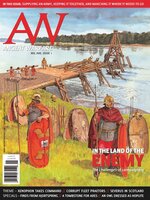
Bridge built soon after Roman conquest of Helvetii
THE TELAMON GRIP • A Telamon is a Homeric term for the strap by which large Bronze Age shields were slung and swung around the bodies of heroes in the Iliad. It has also come to describe, perhaps anachronistically, the rope or cord looped around the interior of Archaic and Classical hoplite aspides (or “Argive shields”) through a series of bronze attachment points. In that later context, its purpose has always been something of a mystery.
Elements of a Greek shield
GENERALS OF THE MARTIAL EMPEROR • By the second century BC, Chinese civilization was blooming under the empire of the Han Dynasty. With this era came various advances in science and technology, the arts, agriculture, and commerce. Some historians have even argued that the Han Dynasty allowed China to become “the most technologically innovative and advanced of all the classical civilizations.”
General Li Guangli and the War for Heavenly Horses
THE 'LITTLE' LUDOVISI SARCOPHAGUS • We saw the Great Ludovisi Sarcophagus back in AW 16.4. It’s smaller brother (hence ‘little’, ‘small’ or piccolo) is, however, just as interesting and is in fact older — dating to ca. AD 170-180. This ‘small’ sarcophagus is well worth an independent examination rather than simply as the smaller of two sarcophagi once owned by Cardinal Ludovico Ludovisi.
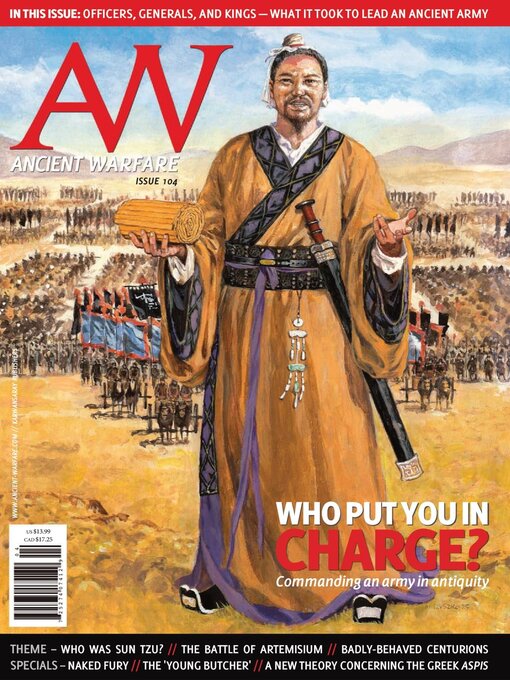
WHO PUT YOU IN CHARGE? • The dangers and risks of warfare were well understood in the ancient world. Vae Victis (woe to the conquered) indeed, as Livy has Brennus tell to the Romans (5.48.9). Wars might turn against you, bringing destruction, hunger, slavery, and death. One of the ways such dangers might be mitigated, and hopefully inflicted upon the enemy, was by appointing the right leader.
THE BURDEN OF COMMAND • By examining the role of commanders in one extensive and well-documented conflict of the Roman Republican era, the Second Punic War (218-201 BC), we can develop an outline of a legion’s command structure, one that simultaneously illustrates the complexities and informal connections that informed military leadership in the mid-Republic.
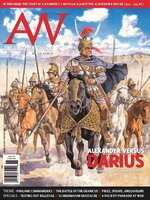
THE VALUE OF EXPERIENCE • A brief overview of the commanders in the army of Alexander the Great quickly shows a pattern of longstanding relationships, trust, proven ability, leading from the front, and how fortune sometimes turned against them at a whim. Only a few survived the lightning campaigns of their young King, fewer yet are known to be depicted in one way or another.
The writing is on the wall
THE BATTLE...